Whole Vanilla Beans vs Vanilla Powder: A Commercial Kitchen Guide
A practical comparison of whole cured vanilla beans and pure ground vanilla powder for bakeries, gelato producers, flavour houses and food manufacturers, covering specs, dosing, labour, consistency and what to confirm before ordering.
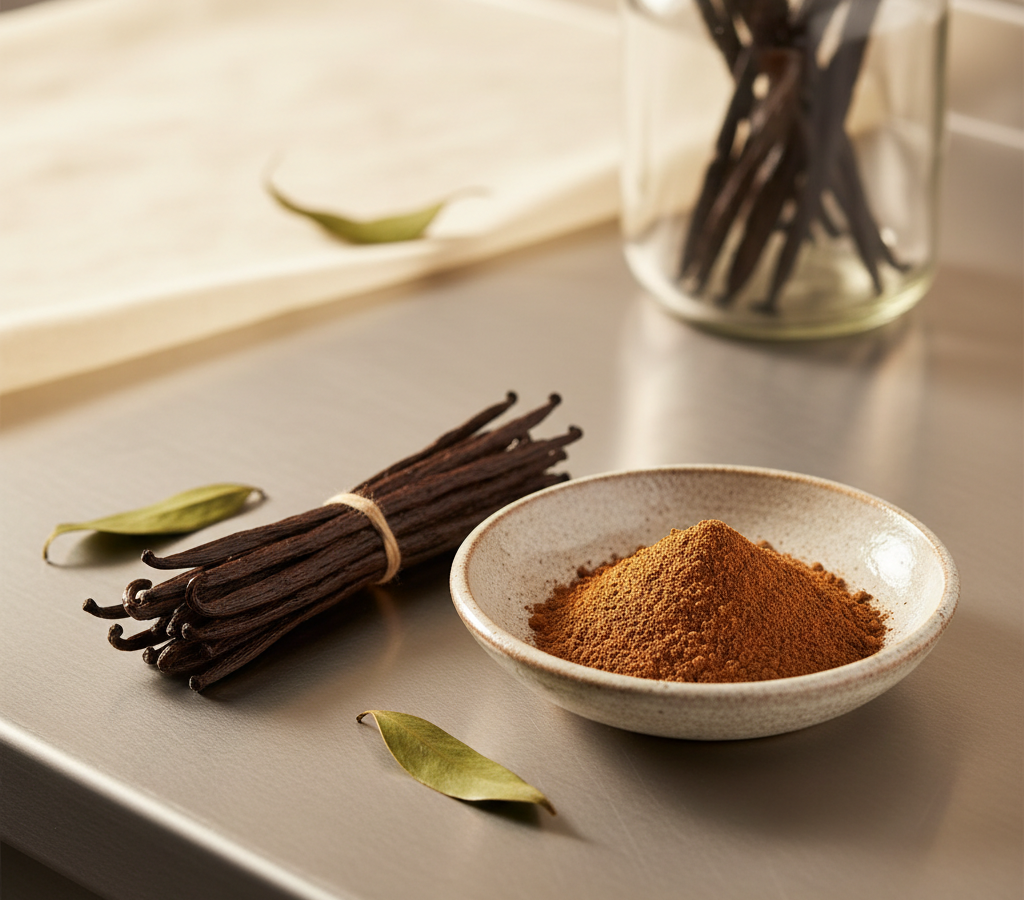
Choosing between whole vanilla beans and pure ground vanilla powder looks like a simple format decision. In commercial practice it is a specification decision: it changes how flavour is dosed, how a batch is reproduced, how much kitchen labour a recipe consumes and how the finished product looks to the customer.
This comparison sets out the practical criteria we use when quoting both formats to bakeries, gelato makers, flavour manufacturers and food processors — including the cases where whole beans remain the better purchase and the cases where powder is the sensible choice.
What Each Format Actually Is
Whole cured beans
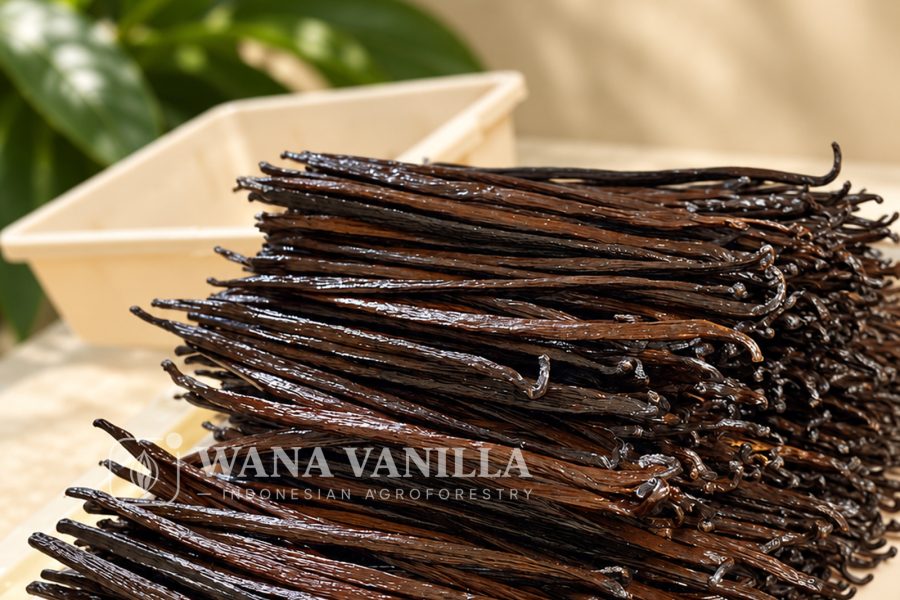
Whole beans are the cured, dried pods of the vanilla orchid, sold by variety and by physical grade. Gourmet lots are normally sorted by length, which is a handling and appearance standard rather than a guarantee of aroma.
- Gourmet Vanilla Planifolia: Grade A+ (18 cm or longer) and Grade A (14–17.9 cm), moisture 25–35%, vanillin at least 1.5%.
- Gourmet Vanilla Tahitensis: the same length grades, moisture 25–35%, vanillin at least 1.5%, with the distinctly different aromatic profile of the Tahitensis species.
- Extraction grade: Planifolia, Tahitensis or a mix, sold for further processing. Extraction grade is not a single standard — moisture and vanillin are quoted per lot, so ask for the actual offer specification and its analytical document rather than assuming a house figure.
Pure ground vanilla powder
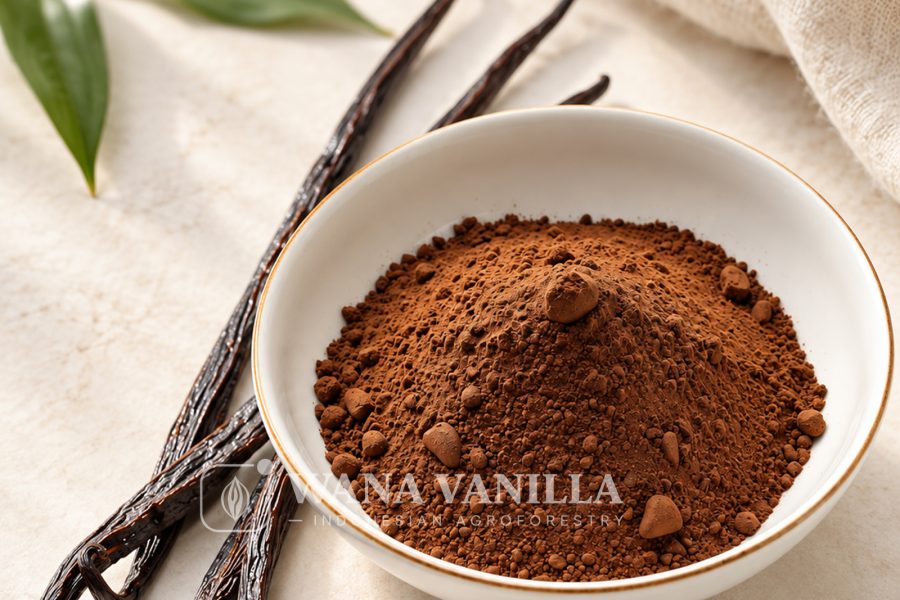
Ground vanilla is milled pod, not an extract and not a concentrate. It carries the full insoluble solids of the bean, which is why it colours and speckles a mix rather than dissolving into it. Check whether a supplier’s powder is 100% vanilla with no carrier or anti-caking addition, because that single question changes both the label declaration and the dosage.
For reference, a sample COA for our pure ground vanilla powder measured 10.89% moisture. That is one measured result on one lot, not a fixed specification for every batch — request the current lot document each time.
Flavour Behaviour and Batch Consistency
- Intact beans hold their volatiles until the moment of use. Splitting and scraping releases aroma at the point where it is needed, which suits infusion, custard bases and anything where the pod can be steeped and removed.
- Bean-to-bean variation is real. Two pods from the same lot can differ slightly in moisture and aroma, so recipes dosed by bean count give slightly different results than recipes dosed by weight.
- Powder gives a more repeatable dose per gram, which matters when a specification sheet has to be defended across production runs.
- Powder does not dissolve. In clear liquids it will settle and read as sediment; in pale ice cream and panna cotta it will read as speckle, which some customers want and others do not.
- Neither format should be swapped for the other, or for extract or concentrate, gram for gram. Vanillin and total solids differ between formats, so conversions have to be set by assay and confirmed by trial batches.
Where Each Format Costs You Time and Money
- Whole beans add a labour step: splitting, scraping, steeping, then straining out the spent pod. That labour is predictable but not free, and it scales badly in high-volume lines.
- Whole beans generate spent pods. Some producers rinse and re-steep them for lower-grade applications; others discard them. Decide the policy before costing a recipe.
- Powder removes the scraping step and can be weighed straight into a dry blend, which makes it the simpler option for dry mixes, biscuits and compound coatings.
- Powder has a much lower moisture level than cured beans, so storage and sealing discipline matter more; it is also more prone to clumping in humid kitchens.
- Both formats should be stored away from heat and light in well-sealed containers. Neither should be judged on price per kilo alone — compare cost per unit of delivered flavour in the finished product.
Matching Format to Application
- Gelato and frozen desserts: whole beans for premium infusions and a visible seed spec; powder where a consistent, reproducible dosage and a coloured base are wanted.
- Bakeries and pastry: beans for crème anglaise, custards, syrups and laminated products where the pod can be infused and removed; powder for sponge, shortbread and dry mixes.
- Flavour manufacturing and industrial food: powder and extraction grade beans are usually the practical inputs, with specifications agreed per lot and supported by analytical documents.
- Small and trial production: start with a 1 kg trial of either format rather than committing to a full pallet, and run it through your own process before setting a purchase specification.
Specifications to Confirm Before Ordering
- Species and variety, country of origin and crop year.
- For beans: grade and length range, moisture range, vanillin content, and how the lot was sorted.
- For powder: whether it is 100% vanilla with no carrier, measured moisture, particle size and mesh, and vanillin content on the lot document.
- Microbiological and extraneous matter results on the specific lot, not on a generic product sheet.
- Packaging format and net weight, since vacuum-packed and bulk-lined cartons behave differently in storage.
Ordering and Logistics
We are PT Wana Vanilla Indonesia, an Indonesian vanilla trading company — not a plantation or a factory. We buy, grade and ship, so our role is to match a lot to your specification and document it honestly. Current indicative monthly capacity is 3,000 kg for gourmet Planifolia, 100 kg for gourmet Tahitensis, 5,000 kg for extraction grade, 1,000 kg for pure ground powder and 2,000 L for alcohol-free natural vanilla concentrate. Trial orders start from 1 kg for whole beans and powder, under EXW, FCA or DAP terms, with international delivery generally arranged by air.
If you are comparing formats for a specific application, tell us the process, the target dosage and the specification you need to defend, and we will quote the format that fits it — or say plainly if a different input would serve you better. You can reach us through wanavanillaindonesia.com.