Packaging and Storage of Whole Vanilla Beans: A B2B Guide
How importers, distributors and manufacturers should pack, store and monitor whole vanilla beans to protect moisture, aroma and vanillin content over time.
Whole vanilla beans are a living, biologically active ingredient. Even after curing, they continue to lose moisture, concentrate flavour compounds, and interact with their packaging environment. For importers, distributors, bakeries and flavour houses, correct packaging and storage are often the difference between a bean that performs beautifully six months later and one that arrives dry, brittle, mouldy or flavour-flat.
This guide outlines the practical considerations we discuss most often with B2B buyers of Planifolia and Tahitensis whole beans, with notes on how packaging decisions interact with grade, moisture range, intended use and shipping mode.
Why Packaging Matters for Whole Vanilla Beans
Gourmet whole beans are typically supplied at 25-35% moisture. Within that range, beans remain pliable, aromatic and suitable for splitting, scraping or infusing. If moisture drops too low, beans become brittle and lose volatile aromatics. If moisture climbs or condenses on the surface, the risk of surface mould increases, especially in warm climates during transit.
Packaging therefore has three jobs at the same time:
- Maintain the bean’s moisture range as closely as possible.
- Protect against oxygen, light and strong external odours.
- Allow safe handling, inspection and traceability through the supply chain.
Recommended Packaging Materials and Formats
There is no single universal format, but the following approaches are common and work well for international B2B shipments:
Primary packaging
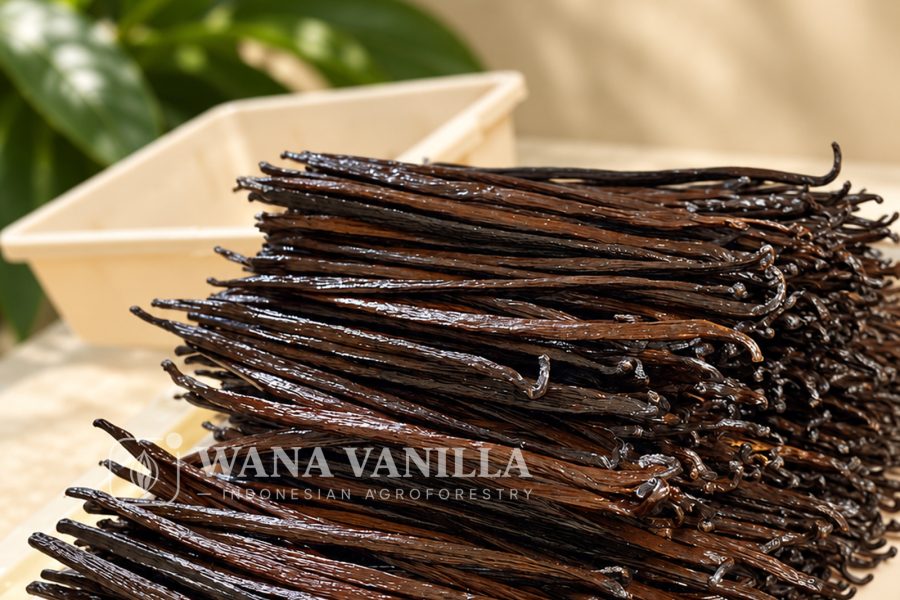
- Vacuum-sealed food-grade plastic bags: the most common format for export. Vacuum packing stabilises moisture, limits oxidation and allows easy counting and inspection. Beans are usually bundled (for example 100 g, 250 g, 500 g or 1 kg) before sealing.
- Zip-lock resealable pouches: suitable for retail-ready or small-format distribution, but less protective over long storage. Best used inside a secondary barrier.
- Food-grade tubes or jars: useful for premium gourmet repacking by distributors, but add cost and weight.
Secondary and transit packaging
- Rigid corrugated cartons lined with food-grade material, sized to prevent movement of inner vacuum packs.
- Desiccant or humidity-indicator strips can be included in the outer carton (not inside the vacuum pack) to monitor transit conditions.
- Clear labelling with batch or lot code, grade, net weight, origin and packing date to support traceability.
For air freight, which is the usual mode for our international deliveries, lightweight but rigid cartons protect beans from crushing during handling at multiple hubs.
Grade and Use-Case Considerations
Packaging choices should reflect the grade and intended application:
- Gourmet Grade A+ (18 cm or longer) and Grade A (14-17.9 cm): these are visual, premium beans. Vacuum packs that preserve suppleness and avoid compression marks are important, particularly for bakery, patisserie and gelato buyers who will present beans whole or split.
- Extraction grade beans (Planifolia, Tahitensis or mix): cosmetic appearance matters less, so bulk vacuum packs of larger weight are efficient. However, extraction houses still care about consistent moisture because it affects solvent ratios and yield calculations.
- Tahitensis gourmet beans: often more aromatic in the anisic/floral direction and sometimes slightly higher in moisture feel; the same vacuum-pack approach applies, but buyers should be aware supply volumes are smaller and lot variation is normal.
Storage Conditions After Arrival
Once beans reach the warehouse, bakery or production facility, storage conditions determine how long they retain quality. General guidelines:
- Temperature: a cool, stable environment, typically around 15-20 degrees C, is widely used. Avoid wide daily swings, which can cause moisture migration inside the pack.
- Humidity: moderate ambient humidity is preferable to very dry air, which accelerates drying once packs are opened.
- Light: store away from direct sunlight and strong artificial light to protect aromatic compounds.
- Odour isolation: vanilla beans both absorb and release strong aromas. Keep them separate from spices, coffee, cocoa and cleaning chemicals.
- Refrigeration and freezing: generally not recommended for day-to-day use. Cold storage can cause condensation on opening, which encourages surface mould. If used for long-term holding, beans should remain in sealed vacuum packs and be brought to room temperature before opening.
After opening
Once a vacuum pack is opened, transfer unused beans to an airtight food-grade container stored in cool, dark conditions. Inspect regularly for surface changes and use a first-in, first-out rotation.
Monitoring, Shelf Life and Quality Checks
Whole vanilla beans do not have a single fixed shelf life; longevity depends on initial moisture, packaging integrity and storage. In well-sealed vacuum packaging under stable conditions, gourmet beans typically remain in good usable condition for many months, with aroma evolving rather than disappearing.
Recommended routine checks for distributors and manufacturers:
- Visual inspection on arrival: colour, pliability, absence of white or green surface mould (note that fine crystalline vanillin “givre” on the surface is a positive sign, not mould).
- Weight checks against packing list to detect moisture loss in transit.
- Sensory evaluation of aroma on opening a representative pack.
- Recording ambient temperature and humidity in the storage area.
For extraction-grade material, buyers typically run their own moisture and vanillin verification per batch, since these parameters can vary across lots and should not be assumed to be identical from shipment to shipment.
Packaging for Related Vanilla Formats
While this article focuses on whole beans, buyers often purchase alongside other formats, each with its own packaging logic:
- Pure ground vanilla powder: typically supplied in sealed food-grade pouches inside cartons. One sample COA measured moisture at 10.89%; individual batches may vary, so protect from humidity after opening.
- Natural vanilla concentrate (alcohol-free, 70%, pH 4.5-5.0, density 1.08 kg/L): packed in food-grade containers suitable for liquids; store cool and sealed, away from light.
Working With Your Supplier
Packaging and storage decisions are easier when buyer and supplier align early. For international orders, it helps to confirm pack sizes, inner weights, labelling fields, carton dimensions and Incoterms (EXW, FCA or DAP) before production. Trial orders from 1 kg for whole beans and powder are a practical way to validate how a specific packaging format performs in your own warehouse and production environment before scaling up.
If you would like to discuss pack formats, grades or trial quantities of Planifolia or Tahitensis whole beans for your operation, you can reach PT Wana Vanilla Indonesia via wanavanillaindonesia.com.