What a Trial Order Reveals About Vanilla Bean Quality
A trial order of vanilla beans is more than a sample. Learn how importers, bakeries and flavour houses use small test shipments to verify aroma, grading and consistency before scaling up.
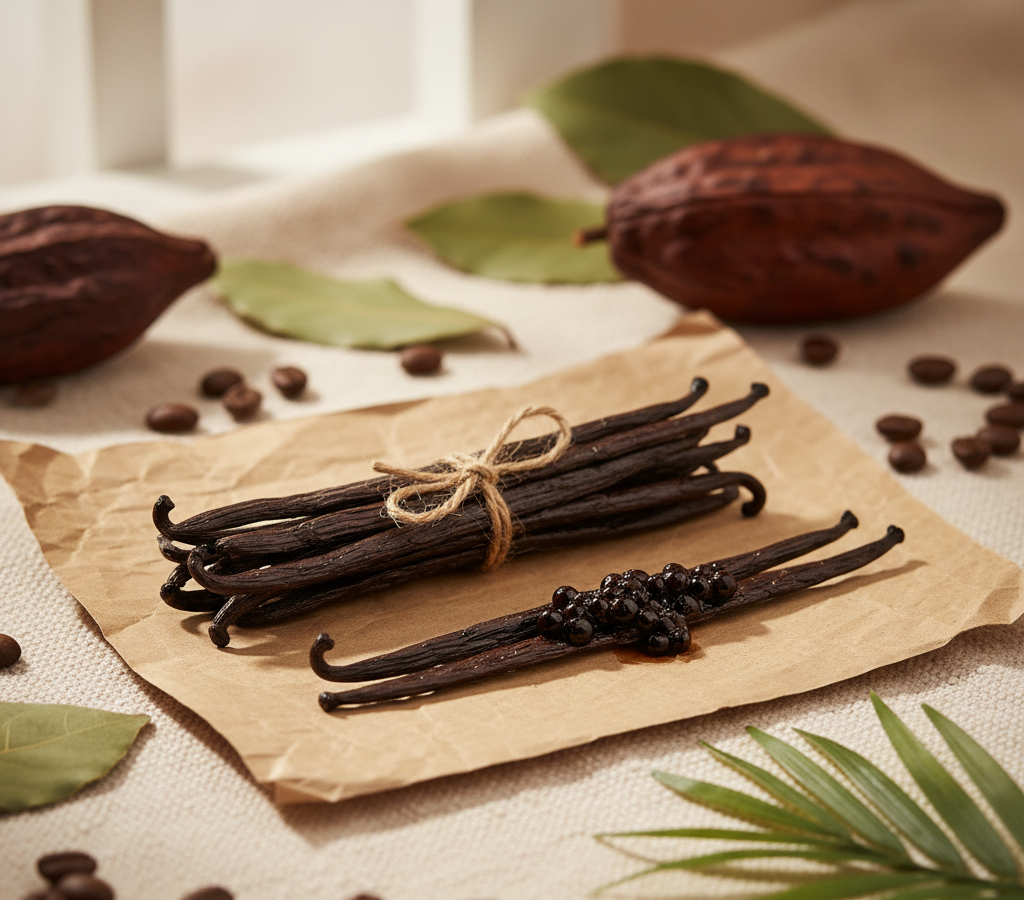
For buyers sourcing vanilla internationally, a trial order is one of the most practical risk-management tools available. Catalogues, specification sheets and photographs can describe a vanilla bean, but only a physical sample in your own facility tells you how the product will behave in your recipe, process and storage conditions.
This article explains what a well-structured trial order can realistically reveal about vanilla bean aroma, grading, moisture, vanillin content and consistency, and how B2B buyers can get the most useful information from small quantities before committing to larger volumes.
Why a Trial Order Matters in Vanilla Sourcing
Vanilla is a natural agricultural product. Even within the same origin, variety and grade, there are legitimate variations between harvests, curing lots and even individual bundles. A trial order lets a buyer verify that what is described on paper matches what arrives in the warehouse, and that the supplier can communicate honestly about those variations.
A trial order typically answers four questions:
- Is the physical quality (length, flexibility, appearance) consistent with the stated grade?
- Does the aroma profile suit the intended end product?
- Are moisture and vanillin levels within the ranges the supplier states?
- Is the packaging, documentation and logistics process workable for repeat orders?
At PT Wana Vanilla Indonesia, trial orders start from 1 kg for whole beans and powder, which is enough for most buyers to run meaningful sensory and basic analytical checks without over-committing capital.
What Aroma Can Tell You in a Small Sample
Aroma is the single most important sensory attribute of vanilla, and it is the attribute that is hardest to standardise on a spec sheet. A trial order lets your team evaluate aroma in three practical ways:
- Raw bean smell: Open the vacuum pack and smell the beans directly. Gourmet Vanilla Planifolia typically presents creamy, sweet, slightly woody notes, while Tahitensis tends toward floral, anise and cherry-like aromatics.
- Behaviour in your matrix: Infuse a split bean in warm milk, cream, sugar syrup or alcohol similar to your actual production conditions. Flavour release at your real process temperature is more informative than theoretical descriptors.
- Finished product trial: Use the sample in a small batch of ice cream, custard, ganache or baked goods. Only this step confirms whether the vanilla carries through heat, fat and sugar as expected.
Flavour houses often go further and run comparative sniff tests between two origins or two grades side by side, which is where trial quantities really pay off.
Checking Grading, Moisture and Vanillin
Length-based grading is a visible, measurable attribute. For Planifolia and Tahitensis gourmet beans, A+ refers to beans 18 cm or longer and A refers to 14 to 17.9 cm. During a trial order you can:
- Measure a random selection of beans and confirm the length distribution.
- Check flexibility; gourmet beans should wrap around a finger without cracking.
- Look for visible mould, dryness, splits or uneven curing.
Moisture content for gourmet beans is stated in a 25-35% range, and vanillin at a minimum of 1.5%. These are ranges, not single fixed numbers. A trial order gives you the opportunity to validate the batch you receive with your own or third-party laboratory, which is far more meaningful than relying on general specifications alone.
For Pure Ground Vanilla Powder, a sample COA has recorded moisture at 10.89%, but this is a specific sample result rather than a guarantee that every production run will deliver identical numbers. Buyers who need tight tolerances should discuss batch-specific COAs when they place a trial order.
Extraction Grade and Concentrate: Different Trial Logic
Extraction Grade Vanilla Beans (Planifolia, Tahitensis or Mix) are evaluated differently from gourmet beans. Appearance matters less, but the ability to deliver flavour and vanillin into an extraction solvent matters more. For a trial, flavour manufacturers typically:
- Run a small bench-scale extraction under their standard solvent, ratio and time.
- Measure vanillin and total extractives in the finished extract.
- Evaluate the organoleptic quality of the extract, not just the beans.
For the Natural Vanilla Concentrate (alcohol-free, 70% natural concentrate, pH 4.5-5.0, density around 1.08 kg/L), a trial focuses on dosage behaviour, solubility in your target matrix, heat stability and label-compatibility with your market’s regulations. Request a technical data sheet alongside the sample so you can plan integration tests properly.
Logistics, Documentation and Repeatability
A trial order is also a test of the trading relationship itself. Pay attention to:
- Incoterms clarity: EXW, FCA and DAP each shift responsibility differently; make sure the chosen term matches your logistics capability.
- Air freight handling: International vanilla shipments are generally sent by air; check vacuum packaging integrity on arrival.
- Documentation: Commercial invoice, packing list, phytosanitary certificate and COA should be complete and consistent.
- Communication speed: How quickly and clearly questions are answered during the trial is a strong predictor of how larger orders will be handled.
How to Structure a Useful Trial Order
To extract maximum value from a small trial, buyers should plan it like a mini-project rather than an impulse purchase:
- Define upfront what you need to confirm (aroma match, grading accuracy, vanillin level, extraction yield, powder flow, concentrate dosage).
- Order the specific grade and variety you expect to buy at scale, not a generic sample.
- Document results so you can compare future shipments against the trial reference.
- Discuss expected ranges with the supplier before testing to avoid misaligned expectations.
With monthly supply capacities of up to 3,000 kg for Planifolia gourmet beans, 100 kg for Tahitensis gourmet beans, 5,000 kg for extraction grade, 1,000 kg for powder and 2,000 L for concentrate, buyers can plan a trial today and scale into a committed supply programme once the quality fit is confirmed.
Talk to Us About a Trial Order
If you are evaluating Indonesian vanilla for your next product or production run, a 1 kg trial of whole beans or powder is a low-risk starting point. You can learn more about available grades and request a quotation at wanavanillaindonesia.com.