Sourcing Indonesian Vanilla as a Complement to Other Origins
A practical B2B guide to adding Indonesian Planifolia and Tahitensis vanilla to a sourcing portfolio already built around Madagascar, Uganda or other origins.
Many vanilla buyers already have an anchor origin, often Madagascar, Uganda, Papua New Guinea or Comoros. The question is rarely whether that origin is good, but whether a single origin is enough to keep production stable through weather events, price cycles and quality variation from one harvest to the next.
Indonesian vanilla, mostly from Java, Sulawesi, Bali and Papua, is one of the practical answers to that question. This article looks at how importers, distributors, bakeries, flavour manufacturers and gelato producers can use Indonesian beans and derivatives as a complement, not a replacement, to the origins they already trust.
Why add a second or third vanilla origin
Relying on one country for a crop as weather-sensitive as vanilla concentrates several risks into one line in your supplier list. A diversified sourcing strategy generally aims to:
- Reduce exposure to cyclones, drought and localised disease pressure in any single growing region.
- Smooth price volatility when one origin spikes due to short crops or speculation.
- Give R&D and production teams access to different sensory profiles for blending.
- Keep contingency lead times reasonable if a primary shipment is delayed.
- Support negotiation leverage with existing suppliers through comparable alternatives.
Indonesia is a credible complement because it is a long-standing vanilla producer, offers both Vanilla planifolia and Vanilla tahitensis, and ships regularly to Europe, North America, the Middle East and East Asia.
Sensory profile: how Indonesian vanilla fits alongside other origins
Flavour descriptors in vanilla are not absolute; curing style, moisture and storage all shift the profile. That said, a few general tendencies help R&D teams decide where Indonesian beans fit.
Planifolia from Indonesia
Indonesian Planifolia typically delivers a classic creamy, woody vanilla character with a slightly drier, more smoky edge than many Madagascar lots. It performs well in applications where vanilla needs to stand up to heat, fat or cocoa: bakery, chocolate, caramel bases and some beverage applications.
Tahitensis from Indonesia
Tahitensis is prized for its floral, anisic, almost cherry-like aroma. Volumes worldwide are much smaller than Planifolia, and Indonesian Tahitensis is similarly limited. It is best reserved for premium pastry, ice cream, patisserie creams and finished products where that distinctive top note is a selling point.
Product formats and realistic use cases
PT Wana Vanilla Indonesia is a vanilla trading company based in Indonesia; it is not a plantation or a factory. Its role is to consolidate, grade and ship products from Indonesian growing regions. The relevant formats for most B2B buyers are:
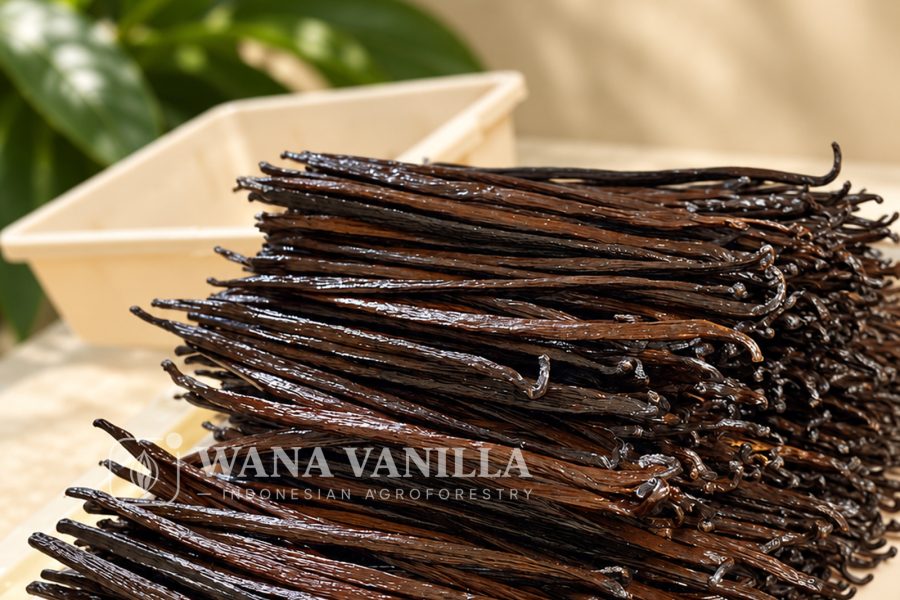
- Gourmet Planifolia whole beans – Grade A+ at 18 cm or longer and Grade A at 14–17.9 cm, moisture 25–35%, vanillin at least 1.5%. Supply capacity around 3,000 kg per month. Suited to visible pod use, pastry, retail packing and premium food service.
- Gourmet Tahitensis whole beans – Same length grading, similar moisture and vanillin thresholds, with a much smaller supply capacity of around 100 kg per month. Order early for seasonal production.
- Extraction grade beans – Planifolia, Tahitensis or mix, supply capacity around 5,000 kg per month. Specifications vary by lot, so request a current COA before each purchase order rather than assuming a fixed spec.
- Pure ground vanilla powder – A reference sample COA recorded moisture at 10.89%. Individual batches will differ; always review the batch COA. Supply capacity around 1,000 kg per month.
- Natural vanilla concentrate – Alcohol-free, 70% natural concentrate, pH 4.5–5.0, density 1.08 kg/L, supply capacity around 2,000 L per month. Useful for formulators who need a liquid vanilla without ethanol.
How to run a structured origin trial
Adding a new origin is not just a purchasing decision; it is a quality and formulation decision. A disciplined trial protects both sides and avoids complaints after a full container arrives.
- Start with a small quantity. Trial orders from 1 kg are feasible for whole beans and powder, which is enough for sensory panels and small production trials.
- Benchmark against your current origin using the same recipe, dosage and process, not an idealised reference.
- Document moisture, visual grading, aroma intensity and any defects on arrival. Do not rely only on supplier data.
- Run shelf-life checks on the finished product, especially for creams, ganaches and ice cream where off-notes develop over time.
- Discuss Incoterms early. EXW, FCA and DAP are all workable; the right choice depends on whether your freight forwarder or the seller is better placed to manage export and air freight.
Logistics, lead times and documentation
International shipments from Indonesia are generally arranged by air for vanilla, which keeps transit short but makes volumetric weight and packaging efficiency important. A few practical points:
- Confirm phytosanitary and commercial documentation requirements with your customs broker before the first shipment, since rules differ by destination country.
- Agree in writing on packaging format: vacuum packs for whole beans, food-grade liners for powder, and appropriate drums or jerricans for the liquid concentrate.
- Plan for seasonal demand peaks. Gourmet Tahitensis in particular has limited monthly capacity and tends to be allocated in advance.
- Do not assume certifications. If you need organic, kosher, halal, HACCP or similar documentation on a specific lot, request written confirmation of what is and is not available for that batch rather than relying on general statements.
Positioning Indonesian vanilla in a multi-origin strategy
For most buyers, the goal is not to replace Madagascar, Uganda or PNG with Indonesia, but to build a portfolio where each origin has a clear role. A workable model is to keep a primary origin for the signature sensory profile, use Indonesia for cost-balanced volume and for Tahitensis character, and keep at least one additional origin on standby for emergencies.
If Indonesian vanilla fits that picture for your operation, request current product sheets, discuss a trial quantity and align on Incoterms before committing to larger volumes. You can start the conversation through PT Wana Vanilla Indonesia and ask for the specific format, grade and documentation your production actually needs.