Ground Vanilla Powder in Bakery and Pastry: Selection and Use
Ground vanilla powder offers bakers and food manufacturers a dry, alcohol-free vanilla format with reliable flavour release. This guide covers product selection, dosing, and practical use in bakery, pastry, gelato and industrial applications.
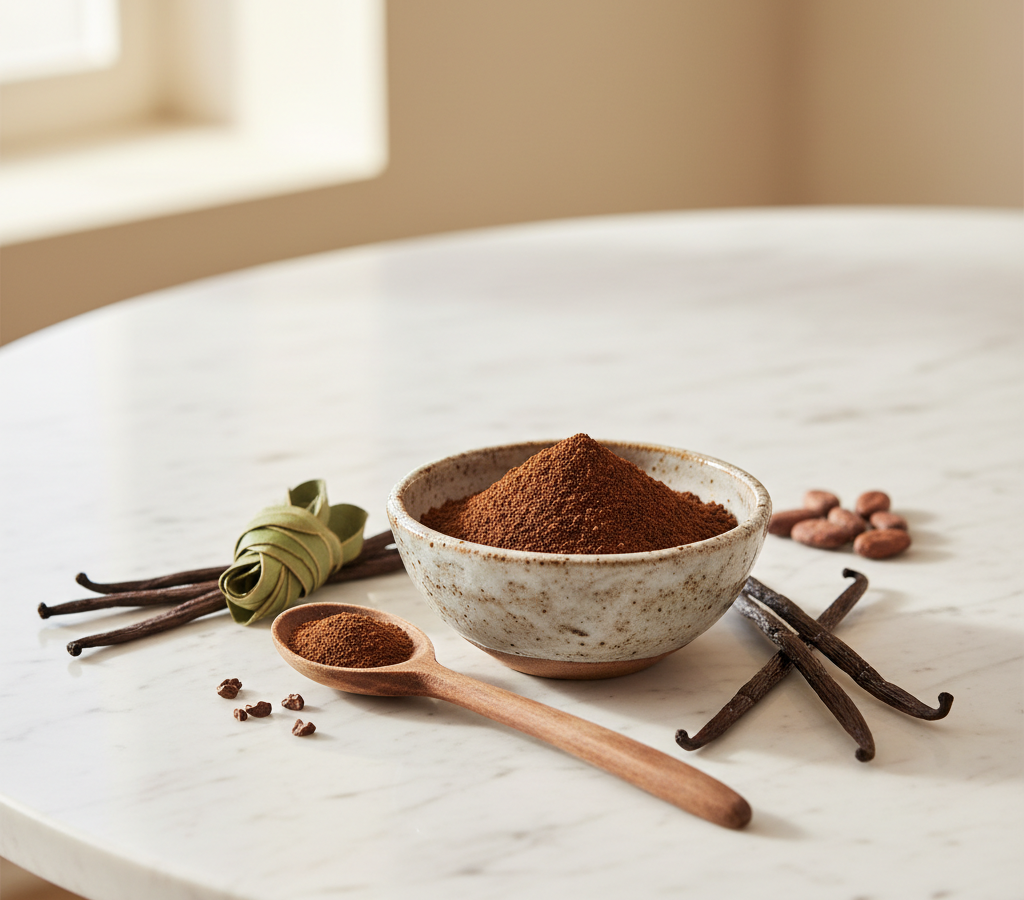
Ground vanilla powder is a practical alternative to liquid extracts and whole beans in many bakery and pastry environments. For importers, distributors and food manufacturers, it offers a dry, alcohol-free format that can be weighed precisely, blended easily with dry ingredients, and stored without the handling constraints of fresh beans or liquid flavourings.
This article explains what pure ground vanilla powder is, how it behaves in different bakery and pastry applications, and what technical and commercial criteria matter when sourcing it for industrial or artisanal use.
What Pure Ground Vanilla Powder Is
Pure ground vanilla powder is produced by grinding cured vanilla beans into a fine, dry powder. It is not the same as vanilla sugar, which is sucrose blended with a small amount of vanilla, and it is not a diluted or compounded flavour. A pure powder contains only vanilla bean material and carries the natural aromatic and flavour compounds of the cured pod, including vanillin and the many secondary compounds that contribute to a rounded vanilla profile.
Because it is dry and concentrated, ground vanilla powder can be incorporated directly into dry mixes, doughs, batters, creams and coatings. It does not introduce water or alcohol, which can be an advantage in formulations where liquid content must be tightly controlled.
Why Bakeries and Pastry Manufacturers Choose Ground Vanilla Powder
Ground vanilla powder is selected for several practical reasons in bakery and pastry production:
- Dry blending: It disperses evenly in flour, sugar, starch and other dry ingredients, reducing the risk of flavour hot spots in large batches.
- No alcohol or water: It suits products where added liquid affects dough rheology, shelf life or labelling.
- Stable storage: A dry powder is less sensitive to microbial spoilage than liquid extracts and does not require refrigerated storage.
- Clean label potential: Depending on the final product and local regulation, it may support simpler ingredient declarations compared with compounded flavours.
- Consistent dosing: Powder can be weighed on standard production scales, which supports batch-to-batch consistency.
For gelato and ice cream manufacturers, ground vanilla powder can be added to the dry mix before pasteurisation and homogenisation. For biscuit, cookie and cake producers, it can be pre-blended with flour or sugar. For chocolate and confectionery makers, it can be milled into coatings or fillings without introducing moisture.
Selection Criteria for B2B Buyers
When comparing ground vanilla powder from different suppliers, buyers should evaluate several technical and commercial factors rather than relying on price alone.
Moisture Content
Moisture affects flowability, clumping, microbial stability and shelf life. A lower moisture content generally supports better dispersion in dry mixes and longer storage. However, moisture can vary between production batches and origins, so buyers should request a certificate of analysis for the specific lot under consideration. A sample COA from PT Wana Vanilla Indonesia, for example, has recorded moisture at 10.89% for one tested batch. This is a useful reference point, but it should not be assumed that every batch will show the identical figure.
Particle Size and Uniformity
Finer, more uniform powders disperse more evenly in batters and dry blends. Coarser powders may leave visible specks, which can be desirable in some premium products but problematic in others. Buyers should request a particle size specification or a physical sample to test in their own matrix.
Vanilla Species and Origin
Ground powder can be produced from Vanilla planifolia, Vanilla tahitensis, or blends. Planifolia typically delivers the classic, robust vanilla profile expected in most bakery products. Tahitensis offers a more floral, anisic character that may suit premium pastry creams, fruit fillings or specialty gelato. Buyers should ask which species or blend is used and whether the powder is made from whole beans or from bean residues after extraction.
Supply Capacity and Lead Time
Commercial buyers should confirm whether a supplier can support recurring volumes. PT Wana Vanilla Indonesia, for example, lists a supply capacity of 1,000 kg per month for pure ground vanilla powder, with trial orders available from 1 kg. This allows importers and manufacturers to validate quality on a small scale before committing to larger volumes.
Practical Dosing and Usage in Bakery and Pastry
Dosing depends on the product, the intensity required and the other flavour sources in the recipe. Because ground vanilla powder is concentrated, it is usually used at lower levels than vanilla sugar.
- Cakes, muffins and sponge products: 0.1% to 0.3% of total batch weight is a common starting range, adjusted after sensory evaluation.
- Cookies and shortbread: 0.2% to 0.5% works well when vanilla is a primary flavour note.
- Pastry cream, custard and fillings: 0.1% to 0.4%, added to the dry sugar or starch before hydration to improve dispersion.
- Gelato and ice cream: 0.1% to 0.3% of total mix weight, blended with sugars before pasteurisation.
- Chocolate and coatings: 0.2% to 0.5%, milled or sieved into the fat phase to avoid clumping.
These figures are starting points, not fixed specifications. Each manufacturer should run sensory and shelf-life trials in its own product matrix. Because vanilla powder is heat-stable in normal baking and pasteurisation conditions, it can be added before processing without major flavour loss, although extended high-heat exposure may reduce some volatile top notes.
Handling, Storage and Quality Control
Ground vanilla powder should be stored in a cool, dry environment, protected from light and strong odours. Sealed packaging with a moisture barrier helps prevent clumping and aroma loss. Once opened, the powder should be used within a defined period and kept tightly closed between uses.
Incoming quality control should include visual inspection, moisture measurement, sensory evaluation and, where relevant, microbiological testing according to the buyer’s own risk assessment. Buyers should also confirm whether the powder contains any carriers, anti-caking agents or added vanillin, since these affect both labelling and performance.
Sourcing Ground Vanilla Powder from Indonesia
Indonesia is a major origin for vanilla, and Indonesian suppliers can offer both planifolia and tahitensis material. PT Wana Vanilla Indonesia is a vanilla trading company based in Indonesia, not a plantation or processing factory. It supplies gourmet whole beans, extraction grade beans, pure ground vanilla powder and natural vanilla concentrate to international buyers.
For ground vanilla powder, the company lists a supply capacity of 1,000 kg per month and offers trial orders from 1 kg. Incoterms available include EXW, FCA and DAP, with international delivery generally arranged by air. Buyers should request a current certificate of analysis and a physical sample for their own evaluation before placing commercial orders.
If you are sourcing ground vanilla powder for bakery, pastry, gelato or flavour manufacturing, contact PT Wana Vanilla Indonesia through wanavanillaindonesia.com to discuss specifications, sample availability and supply terms.