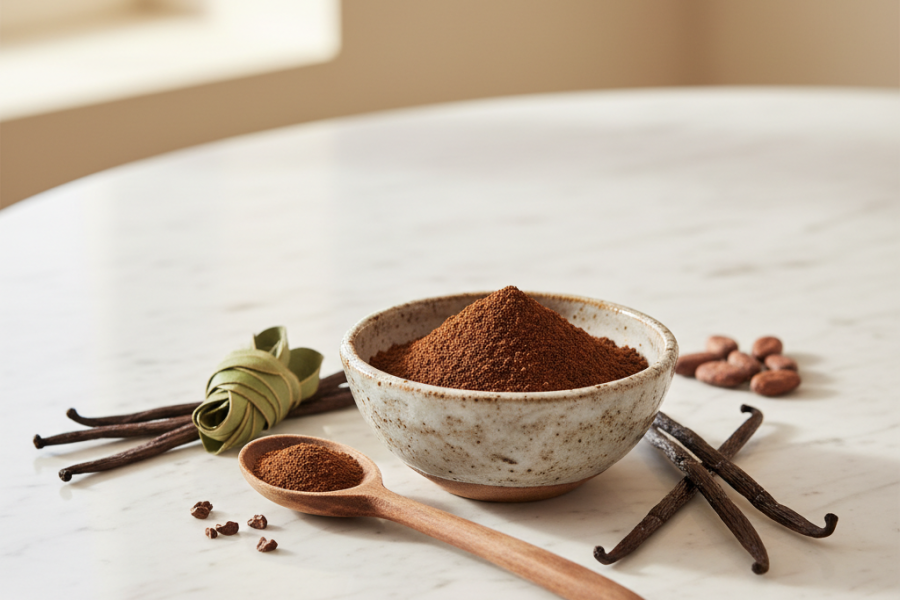
Vanilla Aroma Profiles for Chocolate and Confectionery Products
Vanilla is a formulation decision, not a commodity line. A practical look at Planifolia versus Tahitensis aroma, bean grades, powder and concentrate, and how each performs in chocolate, praline, caramel, bakery and gelato.
Vanilla in chocolate and confectionery is rarely a single purchasing decision. Two species, several grades and four delivery forms all end up in the same finished product, and each one shifts the aroma in a different direction. A buyer who specifies only “vanilla” leaves the outcome to chance; one who specifies species, grade and form controls it.
This article sets out what vanilla actually does in a chocolate or sugar-based matrix, how Vanilla planifolia and Vanilla tahitensis differ on the nose and the palate, and which form suits which application. It is written for importers, distributors, flavour houses and manufacturers who need to justify a choice to their own technical and commercial teams.
What vanilla contributes to a confectionery matrix
Vanilla is used at low dosage but affects several sensory dimensions at once. Understanding those functions makes it easier to judge whether a cheaper grade will work or quietly damage the product.
- Aroma rounding. Vanilla softens the sharper, more acidic and bitter edges of high-cocoa chocolate and dark caramel without sweetening them.
- Perceived sweetness and body. Creamy, balsamic notes can raise perceived sweetness and fat sensation, which matters in reduced-sugar and reduced-fat recipes.
- Carry-through. Vanilla compounds are fat-soluble, so they travel well through cocoa butter, dairy fat and nut pastes but fade faster in high-heat, high-surface-area processes.
- Masking. Vanilla helps cover off-notes from replacers, alternative sweeteners, whey or vegetable-fat compound coatings.
- Signature character. In premium lines, vanilla is often the only ingredient the consumer can name, which makes consistency across lots commercially important, not only sensory.
Planifolia and Tahitensis: two different aroma directions
Species is the first and most useful filter. Both are genuine vanilla, both can be supplied with a vanillin content of at least 1.5%, and both are cured to a 25–35% moisture range in gourmet grades. Their aroma nevertheless reads very differently, because vanillin is only one compound among many.
Vanilla planifolia
Planifolia is the classic profile most buyers recognise. Expect a creamy, balsamic, dried-fruit and cocoa-adjacent character with a rounded, persistent finish. It sits comfortably behind dark and milk chocolate, praline, toffee and baked goods, and it is the safer default when a customer expects “normal” vanilla.
Vanilla tahitensis
Tahitensis is floral, perfumed and anisic, with cherry, ripe fruit and slightly spicy notes. It is louder and more distinctive, and at high dosage it can dominate a delicate matrix. Used with judgement it is excellent in white chocolate, fruit-forward praline, patisserie creams, dairy and gelato, where its lift is an advantage rather than a distraction. It also offers a clear point of difference for brands that want a vanilla story of their own.
Two cautions. First, species alone does not guarantee aroma: curing method, bean maturity and storage history influence the result as much as genetics. Second, high vanillin is not the same as good vanilla; a very vanillin-forward material can taste flat and one-dimensional next to a lower-vanillin bean with richer minor notes.
Matching form and grade to the application
Gourmet whole beans
Whole beans give the fullest aroma because the volatiles stay protected until use. Planifolia is available in A+ (18 cm and longer) and A (14–17.9 cm) grades; Tahitensis is offered in the same length grades but in much smaller volume. Splitting and infusing in cream, milk or cocoa butter suits ganache, ice cream bases, custards and premium bars. The trade-off is labour, extraction time and waste.
Extraction grade beans
Extraction grade is the sensible input for buyers who make their own extract, tincture or percolation. Do not assume a single uniform moisture or vanillin figure for this category: planifolia, tahitensis and mixed lots behave differently, so agree the specification — moisture, vanillin, split ratio, cleanliness — in writing before the first shipment rather than relying on the category name.
Ground vanilla powder
Powder is convenient, disperses evenly and avoids the visible specks-versus-extract debate. It suits compound coatings, biscuit doughs, dry blends and fillings where an alcohol-free, whole-bean-derived ingredient is preferred. Moisture varies between lots; a sample COA measured 10.89%, but that figure describes one batch and should not be treated as a fixed specification. Powder also carries the seed solids, which some consumers read as authenticity and others read as grittiness.
Natural vanilla concentrate
An alcohol-free concentrate at 70% natural strength, pH 4.5–5.0 and density 1.08 kg/L is useful where alcohol is undesirable — some halal, export or low-alcohol declarations, and certain dairy or gelato systems where an alcoholic extract is awkward. It doses by weight, mixes readily into aqueous and emulsified phases, and is straightforward to standardise across production runs.
How to evaluate a sample properly
- Smell the intact pod, then split it and smell again; the difference tells you how much aroma is locked in the interior.
- Check length, suppleness, split percentage, surface mould, foreign matter and moisture, and ask for a certificate of analysis per lot.
- Taste in the real matrix, not in water: dairy, cocoa butter and sugar all change the perception of vanilla.
- Run two or three dose levels against your current material and score aroma, bitterness masking and aftertaste.
- Retain samples from each lot so that drift can be traced later.
Sourcing considerations for buyers
Volumes differ sharply by line. Gourmet planifolia is the workhorse at up to roughly 3,000 kg per month, while gourmet tahitensis is genuinely limited at around 100 kg per month and should be planned well ahead. Extraction grade runs to about 5,000 kg per month, powder to 1,000 kg per month and concentrate to 2,000 L per month. Trial orders start from 1 kg for whole beans and powder, which makes side-by-side bench testing realistic before committing to a container. Incoterms offered are EXW, FCA and DAP, with international delivery generally arranged by air — worth factoring into lead times for high-value, moisture-sensitive goods.
If you are comparing suppliers for a chocolate, praline or gelato project, a specification-led trial is the fastest way to a decision. PT Wana Vanilla Indonesia supplies planifolia and tahitensis whole beans, extraction grade beans, ground powder and alcohol-free concentrate, and can discuss grade, moisture and vanillin requirements against your application. Start at wanavanillaindonesia.com.